A catering counter must do more than present food: it must keep the food cold, accept the right pans, recover after replenishment and remain serviceable in a hot, humid kitchen. By the end, you will be able to compare counter formats, calculate the required capacity and write a purchase specification that covers temperature, airflow, drainage, cleaning and installation.
Key takeaways
- Match the well to pan sizes, portion demand and planned service time.
- Specify air temperature, product temperature and airflow separately.
- Leave ventilation and service access around the refrigeration assembly.
- Use a written cut-out, drainage, electrical and maintenance specification.
How a drop-in refrigerator display counter is assembled
A drop-in refrigerator display counter is a chilled well fitted into a prepared opening in a worktop. Unlike a complete upright cabinet, it is assembled around a cut-out: the counter supports the rim, while the refrigeration assembly cools an insulated compartment below the pans.
The result is a catering display counter that presents chilled food at working height.
Its main parts work together as follows:
- The stainless-steel worktop carries the load and provides the service surface around the opening.
- The support frame holds the drop-in unit level and transfers its weight into the counter structure.
- The insulated well limits heat entering from the worktop and surrounding kitchen.
- The evaporator or cold-air coil removes heat from the well; the refrigeration circuit sends that heat to the condenser.
- The GN pans sit inside the opening and transfer cooling to the food. Dividers control pan arrangement and prevent unused space from disrupting airflow.
- The return-air path draws warmer air back to the cooling section, while the discharge path sends cooled air across the product area.
- The drain carries condensate away, and the service panel provides access to fans, controls and the refrigeration components.
Keep every pan below the marked load line. Overfilled pans block the air path, causing warm spots, icing and long compressor cycles even when the display shows an acceptable temperature. Design around food at 5°C or below, then verify the food with an independent probe.
In Mumbai, request performance tested at the intended hot, humid ambient condition.
Choose the right counter for the food and service method
Choose by the food’s required holding condition and the way staff or customers reach it, not by counter length. A drop-in refrigerated counter holds chilled food in pans set into an insulated, mechanically cooled well.
It suits short-term plating and accessible service when potentially hazardous food stays at 5°C or below; confirm the food category and local compliance rule, then check product temperature with an independent probe.
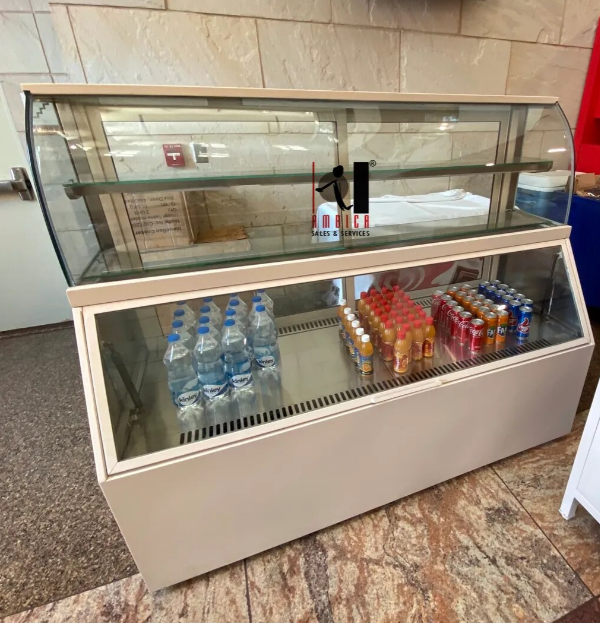
OptionWhat it meansWhen it appliesDrop-in refrigerated counterChilled GN pans sit in a cooled worktop wellSalads, cold desserts, garnishes and plated serviceUnder-counter refrigerator with display topFood stays inside a cabinet beneath the work surfaceLonger storage, protected stock and low customer accessMultideck display caseOpen vertical shelves expose packaged or uncovered productsHigh-visibility self-service with substantial air infiltrationRefrigerated pastry caseEnclosed, front-facing display protects delicate chilled itemsCakes, pastries and desserts needing presentation and hygiene protectionBain-marie counterHeated water or dry wells hold pans hotCurries, rice and sauces held at 60°C or above; not chilled food
An open commercial refrigerated display counter admits warm room air continuously, increasing refrigeration load and causing uneven temperatures if the air curtain is blocked. Doors, sliding lids or night blinds reduce infiltration but restrict access.
In Mumbai, request performance at the intended hot, humid ambient condition, including temperature recovery after loading, rather than trusting the thermostat setting.
Size the well from portions, pans and service time
Pan capacity comes from peak portions between replenishments, not the counter’s overall length. Divide the number of portions needed for each dish during that interval by the portions a filled pan holds, then round up.
A 30-minute rush requiring 150 portions from pans holding 25 portions each needs six pan positions, before allowing for menu variety or a swap-out pan.
Give the fabricator these inputs:
- Peak portions per dish during service
- Replenishment interval in minutes
- GN pan size and depth, such as GN 1/1 at 100 or 150 mm
- Maximum fill height and usable well depth
- Clearance for lids, dividers, hands and serving utensils
- Space around the refrigeration compartment for airflow and service access
Deep pans reduce refilling but slow heat removal from the food core and make the bottom harder to reach. Shallow pans recover temperature faster and improve access, but demand more frequent replenishment. Do not fill above the marked load line; blocked return air can create warm spots and icing.
LayoutBest fitCheck before orderingSingle long wellOne dish in large volumeConfirm GN length and lifting accessDivided wellSeveral dishes with similar service demandVerify dividers preserve airflowMultiple independent wellsDifferent dishes, depths or refill ratesConfirm each circuit’s capacity and clearanceOffset service wellsStaff and customer access from opposite sidesCheck utensil reach and pan removal path
Specify the cut-out, support frame, cabinet depth and condenser location with the pan schedule. A catering display counter that fits by length alone can still lose usable capacity or become unserviceable.
Specify temperature performance, airflow and operating limits
Design around 5°C or below for chilled potentially hazardous food, then verify food temperature with an independent probe during loading and service. A controller reading of 3°C does not prove that every pan is safe.
For a drop in refrigerator display counter, request product-temperature results, the test climate, measurement method and temperature recovery after loading. ISO 23953 testing uses defined test packages and air measurements, so ask for those details rather than accepting a thermostat range.
Write the food type, uncovered or packaged presentation and maximum holding time into the purchase specification.
EvidenceWhat to requestWhat failure it preventsProduct temperatureRecorded food temperatures at the stated load, not only cabinet air temperatureWarm food hidden behind a convincing display readingClimate performanceTested ambient temperature, humidity or ISO 23953 climate class, plus pull-down timeLoss of capacity in Mumbai’s hot, humid roomAirflow and loadingMarked pan load line, clear return-air path, discharge-air pattern and recovery timeWarm spots, icing and excessive compressor running
Set these operating limits in writing:
- Keep pans below the load line and never block the return grille or discharge air curtain.
- State the maximum pan depth, product height, quantity and replenishment interval.
- Specify performance with the service opening exposed for the planned catering duration, not only with an empty cabinet.
- Confirm the room ambient rating and allow for condenser heat from a self-contained unit; a hot small kitchen increases refrigeration load.
A commercial refrigerated display counter is not automatically suitable for uncovered salads, desserts or beverages. Confirm hygiene barriers, airflow and access design for the exact food and service method.
Write an installation and maintenance specification for Mumbai
Do not approve a display counter in Mumbai from its external length alone. The drawing must show the cut-out, support frame, cabinet depth, pan capacity, service clearances and heat-rejection path. Mumbai’s hot, humid ambient increases both refrigeration load and condensate, so request tested holding and pull-down performance at the intended room condition.
1. Confirm construction details: stainless-steel grade and sheet thickness, insulated well dimensions, sealed joints, rounded internal corners, removable pan supports and access panels. Check that the counter can carry the filled pans without distorting the cut-out.
2. Identify the condenser location. A self-contained unit discharges heat into the kitchen; verify ventilation clearance and room heat impact. A remote condenser avoids that discharge but requires refrigerant pipework, insulation, drainage and service access.
3. Specify condensate control: drain size, outlet position, continuous fall, trap, collection tray or condensate pump. A missing drain route will leave water under the counter and can damage flooring.
4. Record the electrical rating, phase, frequency, plug or isolator type, dedicated circuit, MCB size and protective earth. Have an electrician verify the installation before energising the unit.
5. Name the refrigerant and charge, including R290 where offered. Confirm charge limits, ventilation, ignition-source controls and technician requirements; efficiency alone is not a safe selection basis.
6. Demand a cleaning schedule and method. Removable grilles and drains help, but do not hose the cabinet unless its documentation permits washdown and states the enclosure protection.
Ambica Sales & Services can place these items on an equipment schedule for a display counter with drop in refrigerator for catering in Mumbai, rather than leaving them as assumptions. A probe check during loading and service remains essential.
Related products
 Refrigeration
Display Counter Cafeteria
View product → Refrigeration
Display Counter 1
Frequently asked questions
- How is a drop-in refrigerator display counter assembled?
- A drop-in refrigerator fits into a prepared worktop opening. The counter supports the rim, while insulation and the refrigeration assembly form the chilled well beneath the pans. Confirm the cut-out dimensions, rim support, service access, drainage and electrical connection before fabrication.
- How do you choose the right counter for the food and service method?
- Choose the well and pan arrangement based on whether you serve plated meals, buffet portions, salads, desserts or beverages. Check whether the unit is intended for holding pre-chilled food or actively cooling food, then match the layout to customer access and replenishment frequency.
- How do you size the refrigerated well?
- Start with the number and size of gastronorm pans, portion volume and the longest planned service interval. Include space for pan rims, dividers, product rotation and staff access rather than sizing the opening only to the visible food area.
- What should a Mumbai installation and maintenance specification include?
- Specify the cut-out drawing, counter support, insulation, drainage, electrical supply, ventilation clearance, ambient operating limit, thermostat range and product-temperature target. Include cleaning access, condenser cleaning, gasket inspection and a service procedure suited to Mumbai's heat, humidity and coastal conditions.
Related products
 Refrigeration
Display Counter 2
View product → Display
Coloured Two Level Refrigerated Display Counter
Coloured Two Level Refrigerated Display Counter
View product → Display
Beverage and Pastry Display Counter LHS View
Beverage and Pastry Display Counter LHS view
View product → Display
Under Counter Display
Keywords