A small under-sink interceptor may suit a low-volume pantry, but a canteen’s pot washing, batch cooking and meal-period surges can overwhelm it. You will be able to compare the two arrangements, calculate the information a supplier needs, trace the correct waste line and inspect an installation before it creates odour, overflow or blocked drains.
Key takeaways
- Use an under-sink trap for limited flow and a grease box for high-volume discharge.
- Size the interceptor from fixture flow, retention time and local drainage requirements.
- Keep food waste, toilet waste and stormwater out of the grease line.
- Request drawings, flow-rate data, materials, access details and a maintenance plan.
What do “grease trap inside” and “grease box” actually mean?
“Grease trap inside” and “grease box” are usually different equipment types, not simply two names for the same unit. In commercial purchasing, grease trap inside usually means a small hydromechanical interceptor under or beside a sink. Grease box often means a larger gravity interceptor outside, below the floor or in a service area.
Regional usage varies, so the specification must settle the meaning.
| Feature | Grease trap inside | Grease box |
|---|---|---|
| Access | Opened beside working equipment | Accessed through a service cover |
| Capacity | Smaller liquid, grease and solids volume | Larger storage volume and longer service interval |
| Cleaning | Frequent manual scraping and emptying | Pump-out or planned solids removal |
| Odour | Odours enter the scullery if neglected | Odours stay farther from food preparation |
| Installation | Little excavation; pipe routing is simpler | More disruption, excavation and level coordination |
| Overflow consequence | Immediate spill near sinks and staff | Larger release risk if buried, flooded or ignored |
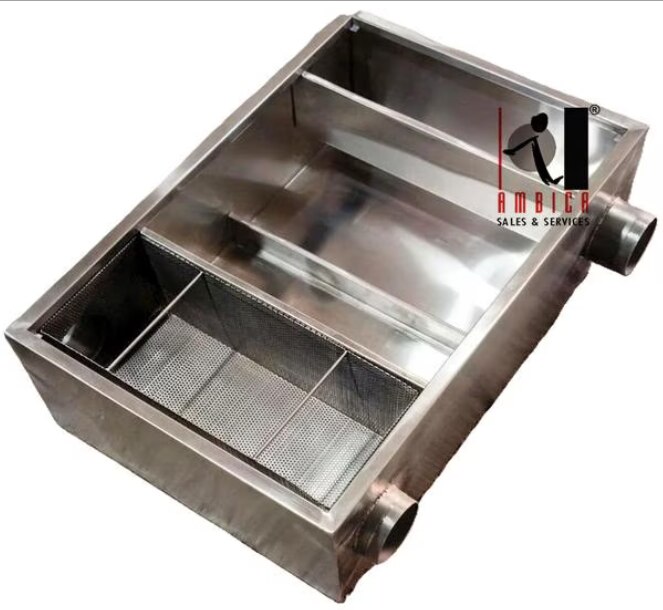
A stainless-steel box is a fabrication choice, not proof of separation performance. A baffled box with no declared hydraulic rating is not equivalent to a tested interceptor.
Request these details before comparing grease trap inside or grease box for canteens:
- Interceptor type, rated flow, grease-storage capacity and solids capacity
- Connection size, flow-control arrangement and access dimensions
- Applicable standard: ASME A112.14.3 or ASME A112.14.4 for hydromechanical units; EN 1825 principles for gravity separators
A matching pipe diameter alone proves nothing. The declared rating and storage capacities determine whether the unit can control peak discharge.
Which option fits your canteen’s flow, menu and available space?
A small internal trap fits a limited-flow scullery; a larger canteen with batch cooking, several sinks, high-fat menus and concentrated lunch discharge usually needs an external or service-area grease box.
| Option | Best fit | Main compromise |
|---|---|---|
| Internal hydromechanical interceptor | One or two sinks, modest meal volume, limited pot washing and manageable dishwashing peaks | Smaller grease and solids capacity; staff must open, scrape and empty it safely without moving permanent equipment |
| External or service-area interceptor | Multiple sinks, heavy pot washing, oily gravies, batch cooking, long drain runs and high lunch-time discharge | Requires routing, excavation or floor space, protected access and planned manual or vacuum servicing |
For grease trap inside or grease box for canteens, choose by peak wastewater flow, not sink volume or nominal pipe diameter. Commercial kitchen grease management fails when a matching 50 mm or 75 mm connection hides an undersized interceptor.
Check these site constraints before choosing:
- Difficult excavation or underground utilities favour an internal unit, but only when its cover remains reachable and staff can service it safely.
- Flooding, vehicle loading, high ambient temperatures in Mumbai or Maharashtra and odour exposure make an outdoor box unsuitable unless it has protection, ventilation and a secure service location.
- A remote box loses its advantage if a vacuum-service vehicle cannot reach the cover, lifting equipment cannot be positioned, or settled solids cannot be removed.
- Keep the drainage arrangement clear: pot sinks, pre-rinse sinks, floor drains and dishwashers need an approved fixture schedule; do not assume every handwash basin belongs on the grease line.
The most accessible option is the maintainable one, not automatically the unit with the largest pipe.
How do you size the interceptor and choose the fixtures it serves?
Size the interceptor from peak wastewater flow, not sink volume alone. Add the simultaneous discharge from connected sinks and canteen scullery equipment during the busiest washing period, then check the result against the unit’s grease-retention and solids-storage capacities.
Before choosing a grease box or indoor interceptor, record:
- Discharge rate from each sink, dishwasher and waste-processing machine.
- Flow-control provisions, wastewater temperature, grease density, detergents and other influencing substances.
- The required 50 mm or 75 mm connection size and the interceptor’s declared rated flow.
A matching 50 mm or 75 mm pipe proves only that the pipe connection fits; it does not prove that the interceptor can slow the combined flow or retain grease. Hot, detergent-rich commercial dishwasher water can emulsify grease and carry it through, so obtain specific approval before connecting it.
A disposer or pulper can fill the solids zone quickly and may need screening, a separate solids interceptor or a larger combined design.
| Fixture or equipment | Usual connection decision | Check before approval |
|---|---|---|
| Pot-wash or pre-rinse sink | Connect to grease control | Grease and settled-solids load |
| Scullery floor drain | Connect only if permitted | Written drainage-authority approval |
| Handwash basin | Keep separate from grease-laden fixtures | Approved drainage design |
| Commercial dishwasher | Do not assume connection | Manufacturer and authority limits |
| Disposer or pulper | Screen or provide separate solids control | Solids capacity and cleaning access |
Use the approved fixture schedule, authority requirements and manufacturer’s limits for commercial kitchen grease management; a generic catalogue diagram does not override them.
How should the canteen waste line and interceptor be installed?
Before commissioning, trace the canteen waste line against a marked fixture schedule showing every pot sink, pre-rinse sink, floor drain, dishwasher, disposer and handwash basin. Keep grease-laden waste separate from toilets, stormwater and unsuitable connections; confirm each connection with the drainage authority and interceptor manufacturer.
1. Check flow direction: the inlet and outlet arrows must match the pipe run, and baffles must sit in their specified positions. A reversed outlet or missing baffle can send grease directly downstream.
2. Inspect the removable, gasketed access cover, vent, upstream clean-out and downstream clean-out. Provide adequate pipe slope, compatible invert levels and watertight joints. Do not bury the cover beneath fixed canteen scullery equipment; leave enough clearance to lift it and remove grease and settled solids safely.
3. Confirm the interceptor’s operating conditions. It separates FOG by slowing flow so grease rises and solids settle. Excessive velocity, turbulence, hot water, emulsifying detergent and food solids reduce performance, especially in a small grease trap inside.
4. Protect an external box from vehicle loads and flooding, and plan either safe manual servicing or vacuum-truck access. A large box that no service worker can reach is a poor commercial kitchen grease management installation.
Use the 25% combined grease-and-solids level as a service trigger: inspect when those layers reach about one-quarter of the liquid operating depth. This does not prove correct sizing. Canteens using disposers, pulpers or heavy-solid menus need earlier inspections and cleaning.
What should you request from an equipment supplier before approving the purchase?
Reject a polished stainless-steel enclosure that gives no rated flow, capacity or performance data. For a grease trap inside or grease box for canteens, compare documented performance and maintainability at the canteen’s actual peak flow, not the trade name or metal finish.
Request these items in writing:
- Declared rated flow and connection diameter
- Grease-storage volume and solids-storage volume
- Flow-control arrangement, including the control device location
- Tested standard or hydraulic test evidence
- Dimensioned internal baffle drawing
- Access-cover dimensions and lifting clearance
- Gasket material and replacement procedure
- Weld specification and passivation requirements
- Vent, inlet clean-out and outlet clean-out details
- Inlet and outlet installation levels, invert levels and required pipe slope
- Cleaning instructions covering floating grease and settled solids
- Approved fixture schedule showing sinks, floor drains, dishwasher drainage, disposers and excluded fixtures
| Quotation detail | Acceptable evidence | Warning sign |
|---|---|---|
| Rated flow and storage | Test report or declared figures tied to the model | Only a pipe diameter |
| Internal construction | Baffle drawing, access dimensions and gasket specification | “Stainless steel box” alone |
| Maintenance | Method for removing settled solids, not only pumping floating grease | No solids-removal method |
Ask how staff will remove settled solids; leaving them reduces working volume and pushes food into the drain. Ambica Sales & Services can be compared with other commercial kitchen equipment suppliers when the quote must coordinate canteen scullery equipment with sink units, pipe grating, dishwasher drainage, pot-wash layout and service clearance.
Related products
 | Scullery Grease Trap Inside View product → |
 | Scullery Grease Trap with Non Skid Lid View product → |
Frequently asked questions
What is the difference between a grease trap inside and a grease box?
A grease trap inside usually means a small hydromechanical interceptor installed under or beside a sink. A grease box usually means a larger gravity interceptor installed outside, below the floor or in a service area.
Which grease interceptor suits a canteen kitchen?
Choose an internal trap for a low-flow sink or isolated fixture with short discharge runs. Choose a grease box when the canteen has high wash-up volumes, several connected fixtures or enough service-area space for cleaning access.
How do you size a grease interceptor for a canteen?
Calculate the connected fixture discharge, peak simultaneous use and required retention time, then confirm the selected capacity and flow rate against the local drainage authority’s requirements.
Which fixtures should connect to a canteen grease interceptor?
Connect pot-wash sinks, dishwashing sinks, pre-rinse sinks and suitable floor drains that carry greasy wastewater. Keep toilets, handwash basins, stormwater and food solids out of the grease line.
What should you request from a grease interceptor supplier?
Request a dimensioned installation drawing, inlet and outlet sizes, rated flow, capacity, materials, baffle details, access and cleaning clearances, maintenance instructions and warranty terms.
Keywords